Showing posts with label preservatives. Show all posts

Friday, September 14, 2012

WARNING: Pickles that can kill

A few weeks ago when I made a HUGE batch of pickles I used a recipe that called for garlic, onions, and dill. This recipe made the best pickles I've ever tasted, however, I was informed by my mom that garlic if stored in liquid can cause botulism. I've heard of this term once or twice in conversation with canning tomatoes, but I never really paid much attention to it. 

Well, now it has caught my attention, since I have to drain and re-jar 7 giant bottles of pickles. I left the garlic in the jars thinking it would enhance the flavor, but little did I know that it could cause botulism.

Botulism, if you aren't aware, is a bacteria that grows on certain vegetables when stored improperly. It is deadly, and will kill you rather fast- like in days.

So, if you made my pickles I'm sorry, but you are going to have to take the garlic out of the jars, just like I did. This is especially important if you are jarring and not keeping them in the refrigerator, or not planning on eating them right away. Here is a warning I found:

BOTULISM WARNING 
Regardless of its flavor potency, garlic is a low-acid vegetable. The pH of a clove of garlic typically ranges from 5.3 to 6.3. As with all low-acid vegetables, garlic will support the growth and subsequent toxin production of the bacterium Clostridium botulinum when given the right conditions. These conditions include improper home canning and improper preparation and storage of fresh herb and garlic-in-oil mixtures. Moisture, room temperature, lack of oxygen, and low-acid conditions all favor the growth of Clostridium botulinum. When growing, this bacterium produces an extremely potent toxin that causes the illness botulism. If untreated, death can result within a few days of consuming the toxic food. 

...WHICH MEANS YOU ARE AT RISK OF GETTING SICK FROM STORING IT THE WAY YOU DO.
STORING GARLIC.
Commercially, garlic is stored near 32 degrees F. However, most home refrigerators are too warm for ideal long-term storage of garlic. Instead, store in a cool, dry, well-ventilated place in well-ventilated containers such as mesh bags. Storage life is 3 to 5 months under cool (60 degree F) dry, dark conditions. 

WHICH MEANS YOU CAN SAFELY KEEP IT IN A COOL DRY PLACE AT HOME INSTEAD OF PUTTING IT IN OIL. 

FREEZING GARLIC 
Garlic can be frozen in a number of ways.1. Chop the garlic, wrap it tightly in a plastic freezer bag or in plastic wrap, and freeze. To use, grate or break off the amount needed.2. Freeze the garlic unpeeled and remove cloves as needed.3. Peel the cloves and puree them with oil in a blender or food processor using 2 parts oil to 1 part garlic. The puree will stay soft enough in the freezer to scrape out parts to use in sautéing. Freeze this mixture immediately - do not store it at room temperature. The combination of the low-acid garlic, the exclusion of air (by mixing with oil), and room-temperature storage can support the growth of Clostridium botulinum.  

THESE ARE THE SAFER OPTIONS, BECAUSE STORING IT IN OIL TAKES AWAY ITS OXYGEN(DROWNS IT) AND THEN IT BECOMES DANGEROUS TO EAT.

STORING GARLIC IN OIL 
Extreme care must be taken when preparing flavored oils with garlic or when storing garlic in oil. Peeled garlic cloves may be submerged in oil and stored in the freezer for several months. Do not store garlic in oil at room temperature. Garlic-in-oil mixtures stored at room temperature provide perfect conditions for producing botulism toxin (low acidity, no free oxygen in the oil, and warm temperatures). The same hazard exists for roasted garlic stored in oil. At least three outbreaks of botulism associated with garlic-in-oil mixtures have been reported in North America.  

By law, commercially prepared garlic in oil has been prepared using strict guidelines and must contain citric or phosphoric acid to increase the acidity. Unfortunately, there is no easy or reliable method to acidify garlic in the home. Acidifying garlic in vinegar is a lengthy and highly variable process; a whole clove of garlic covered with vinegar can take from 3 days to more than 1 week to sufficiently acidify. As an alternative, properly dried garlic cloves may be safely added to flavor oils." 

SO IT IS SAFE TO SUBMERGE THE GARLIC IN OIL AND THEN FREEZE BUT NOT REFRIGERATE OR LEAVE AT ROOM TEMPERATURE. 

Now it says above that it acidify garlic in vinegar is a safe way to prevent botulism, which my pickles are in a lot of vinegar, but I'm not going to take the chance, and you shouldn't either. I read that in order to acidify garlic properly it must be soaked/submerged in vinegar for 3-7 days. (Which I did not.) I'd err on the side of caution and do it for a full 7 if you are so inclined to do this.

Operation-remove-garlic-from-pickles is about to start. 

Friday, July 13, 2012

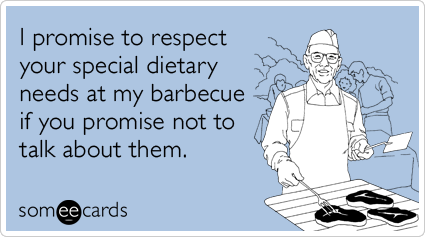
What to do at a BBQ


As someone who always ends up in conversations with people about the food we eat, I fully understand not being a burden at a party. Most people haven't wrapped their mind around all the damage that the standard American diet causes. But as someone who cares about what I eat, it can be challenging going to someone else's house and finding something that I feel comfortable eating. Let me preface this by saying, sometimes I really don't give a S-H-I-T (usually if I am starving) and I will eat anything that's there. I hardly ever eat much meat during the week, so when I am out at a party I am sometimes more inclined to eat it. But most of the time I am at least a little picky.

I wasn't always this calm, cool, and collected about not beating myself up about eating 100% healthy all the time. I would work myself into a mental knot about whether I should eat the chemical filled, preservative laden, over processed, but really good something-or-other. Then I would eat it and feel guilty afterwards. Meanwhile, I'm at a party, but not really enjoying myself because I know I'm literally eating garbage.

This is what you do. Bring something you can eat. Not only will you look like a courteous guest, but you will be able to load your plate with whatever you brought and pick at the other things.

The things that I am picky about are:

  • conventional meat especially chicken (conventional chicken ABSOLUTELY disgusts me and if you knew how it was raised you would be grossed out too)
  • conventional dairy and eggs (same as above)
  • anything that comes out of a bag, box, looks florescent in color, originates as a powder, you get the drift
Most importantly, if there is absolutely nothing "healthy" where you are, pick the least bad things, and eat them anyway, and don't beat yourself up about it. You can make up for it tomorrow. I try to follow the 80/20 rule. 80% of the time I eat super healthy, and 20% of the time I am more relaxed about what I am eating so I can go out, have fun, and not drag a cooler of food with me everywhere I go.

Have fun this weekend!

Thursday, December 8, 2011

Twinkies vs. Carrots


While I do not agree with Michael Pollan that carrots should be subsidized...I do agree that there is a major problem with our food industry. I believe that the government should stay out of business...and food is a business too.


It's very simple. If you want whole foods, shop the perimeter of the grocery store. Whole foods will be along the walls of the grocery store.

Do you get "sucked in" to the goodies in the middle of the supermarket?

Sunday, September 11, 2011

Food vs. Food Like Substances


Author Michael Pollan talks about his rules for eating food vs. food like substances (what most of Americans eat) and some of his thinking behind his convictions. I just finished one of his books, In Defense of Food and it is was a great awakening to me that WE DON'T EAT FOOD...WE EAT THE PRODUCTS OF FOOD SCIENCE! 


Food is:
  • Fruits
  • Vegetables
  • Whole Grains
  • Beans
  • Legumes
  • Fresh Dairy
  • Humanely-raised Meat
  • Herbs
  • Spices

Food Like Substances are:
  • Gogurt Portable Yogurt
  • Protein Bars
  • Lucky Charms Cereal
  • Entenmann's Apple Puffs
  • Oreos
  • Frozen Dinners
  • Easy Mac Macaroni & Cheese

I have been in the process of changing over my diet from food like substances to food for the past year. These are some easy ways to make small changes quickly that will make a huge impact in the way that you feel.

  • Buy organic dairy. This ensures that there are no hormones or antibiotics fed to the cows which end up in your body after you eat their dairy products.
  • Buy grass-fed or humanely raised meat. This ensures that these animals are raised on their natural diet and allowed to exhibit their natural behaviors. The animal is healthier, the meat is healthier.
  • Do not buy anything containing hydrogenated oils or high fructose corn syrup. These are two toxic food additives that harm you every time you eat them. HFCS makes everything taste sweeter which feeds your cravings for more sweets, and hydrogenated or partially hydrogenated oils make food like substances last for years on the shelves (gross!).
  • Replace one meal with a fruit and vegetable smoothie. Any blender (you know... the one you bought to make margaritas and mudslides) will do. I buy a huge batch once a week (usually no more than $30-$40 worth) and it lasts me just about all week. I try to put at least 5 different fruits and/or vegetables in my smoothies. I find that when I make a healthy choice in the morning it ripples through my food choices for the rest of the day. Plus you will find it will make you feel amazing!
  • Do not stress about eating healthy all the time. Or you may become ORTHOREXIC! Just kidding. Make healthy choices as often as you can, and when there is absolutely no possible way of eating something healthy (fruits, veggies, food that is not heavily processed, or covered in gobs of cheese) just think of it as your free pass to indulge in something you would not normally eat but you enjoy.

If you make only these 5 changes you will start to feel the positive effects. You don't have to "go to extremes" like eating only raw food, eating no meat, or not accepting dinner invitations because you know they will not be serving "healthy" food. These 5 upgrades will make a positive change in your life. 

Sunday, August 28, 2011

FDA & Other Health Associations...I wouldn't trust them


On this windy, post-hurricane Sunday afternoon I find myself sitting in bed reading Michael Pollan's In Defense of Food. I have been reading a few pages at a time every night before I go to sleep so it has taken longer than necessary to get through (not because it is uninteresting, but because I am genetically predisposed to falling asleep after reading about 5 pages). I just read something that I would like to discuss, as I brought up the subject of bogus food labels in a previous post about whole grains. Below is the excerpt from Pollan's book:

"When corn oil and chips and sugary breakfast cereals can all boast being good for your heart, health claims have become hopelessly corrupt. The American Heart Association currently bestows (for a fee) its heart-healthy seal of approval on Lucky Charms, Cocoa Puffs, and Trix cereals, Yoo-hoo lite chocolate drink, and Healthy Choice's Premium Caramel Swirl Ice Cream Sandwich- this at a time when scientists are coming to recognize that dietary sugar probably plays a more important role in heart disease than dietary fat. Meanwhile, the genuinely heart healthy foods in the produce section, lacking the financial and political clout of the packaged goods a few aisles over, are mute. But don't take the silence of the yams as a sign that they have nothing valuable to say about health. Bogus health claims and food science have made supermarkets particularly treacherous places to shop for real food..."
This brings up a couple of topics. First is the difference between food and food products. Food is, as Michael Pollan discusses in this book, something that your great grandmother would have ate- whole foods and home cooked foods with minimal ingredients. Food products, the majority of what stocks our supermarket shelves, are food like concoctions that have been stripped down of all of the ingredients' natural health benefits so the so called food can last indefinitely on the shelves or freezer. In order to have any "health claim" to advertise on the food products they are then fortified, enriched, and supplemented.

That brings me to the second topic which is the labeling that Big Food companies put on their food products. I am going to seriously try to keep my opinions about how politicians have no business getting involved in what we eat, however I find it extremely hard since the two (government and big food) have become so intimately acquainted in the past century.  I want you to seriously think for a minute...if you are looking at a box of Cocoa Puffs or a package of caramel ice cream that is boasting being heart healthy, DO YOU REALLY BELIEVE IT? Then once you have your answer (hopefully it is NO) take a look at the ingredients list. Is there anything on that list that you do not recognize? that you can not pronounce? that you think may be unhealthy or unnecessary? (I would bet money that your answer to all of them would be YES)

Then ask yourself...WHY THE HELL AM I EATING THIS GARBAGE? AND (EVEN MORE IMPORTANTLY) WHY AM I FEEDING IT TO MY KIDS?

Read labels! Don't be fooled by health claims on packaged food. Spend more time in the produce section!

P.S. I am currently working on a list of food brands that are good for you that have real food ingredients in them. It will be a short list (unfortunately) but I will create a page on this blog listing all of them soon!

Monday, August 22, 2011

What the hell am I eating?

Since my last post, I have been reading, cooking, and investigating- alot! I have learned a tremendous amount of information about the food that is available to us. 99.9% of the food we buy is garbage. Even the brands and restaurants that claim "ALL NATURAL" or "HEALTHY" are full of chemicals (literally). I will break it down in future posts, but everyday I learn something new, and today I learned about the vegetable sandwich that I ate for lunch. 

Not actual sandwich, but close

I didn't bring my lunch, and only had a short time to eat. I thought 'what is the healthiest place I can eat within 5 minutes of my office?' PANERA! I got my typical Mediterranean Veggie Sandwich (with an apple). As I was eating it I was looking at what was in it- red onion, cucumbers, tomatoes, red peppers, feta cheese, pesto, and lettuce on bread. Looks healthy, tastes good! There was a spicy something in it that I couldn't recognize so I went to Panera's website. 

Well, on Panera's website you can pick each item to get its nutritional information and ingredients. I have learned that in order to be "eating healthy" an item really should not have more ingredients than I can count on one hand OR ingredients that I cannot pronounce (which goes hand in hand with not knowing what the hell it is). 

Here is the list of items (and brief description of what they are) that I either could not pronounce or didn't know what they were in my VEGETABLE sandwich:

**All information about the ingredients was found on Wikipedia.com

- Phosphoric acid  is used to acidify foods and beverages such as various colas, but not without controversy regarding its health effects. It provides a tangy or sour taste and, being a mass-produced chemical, is available cheaply and in large quantities. 

- Sodium Benzoate  is a preservative. In combination with ascorbic acid (vitamin C, E300), sodium benzoate and potassium benzoate form benzene, a known carcinogen. Wonderful! because this sandwich has ascorbic acid in it!

- Potassium Sorbate is a preservative used to inhibit molds and yeasts in many foods, such as cheese, wine, yogurt, dried meats, apple cider, soft drinks and fruit drinks, and baked goods. Potassium sorbate is considered to be safe because of its long term safety record and non-toxic profile. Potassium sorbate is non-irritating and non-sensitizing. Allergic reactions are rare, and it is well tolerated when administered internally. 

- Malted Flour is a process applied to cereal grains, in which the grains are made to germinate by soaking in water and are then quickly halted from germinating further by drying with hot air.

- Ferrous Sulfate Together with other iron compounds, ferrous sulfate is used to fortify foods and to treat iron-deficiency anemia. Constipation is a frequent and uncomfortable side effect associated with the administration of oral iron supplements. Stool softeners often are prescribed to prevent constipation. Panera should serve a stool softener as a side to my sandwich.

- Thiamine Mononitrate (Vitamin B1) is found in a wide variety of foods at low concentrations. In general, cereal grains are the most important dietary sources of thiamine, by virtue of their ubiquity. Of these, whole grains contain more thiamine than refined grains, as thiamine is found mostly in the outer layers of the grain and in the germ (which are removed during the refining process). For example, 100 g of whole-wheat flour contains 0.55 mg of thiamine, while 100 g of white flour contains only 0.06 mg of thiamine. In the US, processed flour must be enriched with thiamine mononitrate (along with niacin, ferrous iron, riboflavin, and folic acid) to replace that lost in processing. So if food manufacturers used whole grains instead of white refined flours there would be no need to fortify them with all of these vitamins. 

- Riboflavin (Vitamin B2) Riboflavin is yellow or yellow-orange in color and in addition to being used as a food coloring, it is also used to fortify some foods. The milling of cereals results in considerable loss (up to 60%) of vitamin B2, so white flour is enriched in some countries such as USA by addition of the vitamin. The enrichment of bread and ready-to-eat breakfast cereals contributes significantly to the dietary supply of vitamin B2.

- Folic Acid (Vitamin B9) is essential to numerous bodily functions. The human body needs folate to synthesize DNA, repair DNA, and methylate DNA as well as to act as a cofactor in biological reactions involving folate. It is especially important in aiding rapid cell division and growth, such as in infancy and pregnancy, as well as in "feeding" some cancers. While a normal diet also high in natural folates may decrease the risk of cancer, there is diverse evidence that high folate intake from supplementation may actually promote some cancers as well as precancerous tumors and lesions. AMAZING! So when you think you are getting necessary vitamins from all of these enriched foods, you are actually increasing your risk of developing cancer. FYI.... spinach, asparagus, beans, peas, lentils, egg yolks, bakers yeast, and sunflower seeds are all sufficient sources of naturally occurring folate. 

- Natural Flavor according to the U.S. Code of Federal Regulations a "natural flavorant" is the essential oil, oleoresin, essence or extractive, protein hydrolysate, distillate, or any product of roasting, heating or enzymolysis, which contains the flavoring constituents derived from a spice, fruit or fruit juice, vegetable or vegetable juice, edible yeast, herb, bark, bud, root, leaf or any other edible portions of a plant, meat, seafood, poultry, eggs, dairy products, or fermentation products thereof, whose primary function in food is flavoring rather than nutritional. So when I order my veggie sandwich I could actually be eating parts of an animal or fish. Good news for vegetarians and vegans because natural flavoring is in many more foods than you would think!

- Artificial Flavor Flavoring substances not identified in a natural product intended for human consumption, whether or not the product is processed. These are typically produced by fractional distillation and additional chemical manipulation naturally sourced chemicals or from crude oil or coal tar. Although they are chemically different, in sensory characteristics are the same as natural ones. I don't know about you but I love eating chemically manipulated substances that come from crude oil or tar.

- Monoglycerides & Diglycerides are commonly added to commercial food products in small quantities. They act as emulsifiers, helping to mix ingredients such as oil and water that would not otherwise blend well. The commercial source may be either animal (cow- or hog-derived) or vegetable (soy- which is a whole other topic), and they may be synthetically made as well. There are natural emulsifiers such as honey or egg yolks which do not come from unspecified animal parts. 

- Citric Acid is a weak organic acid. It is a natural preservative and is also used to add an acidic, or sour, taste to foods and soft drinks. It is obtainable from lemons and limes. However, most citric acid in the food industry is not extracted from citrus fruit, but fermented by Aspergillus niger mold from scrap molasses, waste starch hydrolysates and phosphoric acid. 

- Polysorbate 60 is one of a class of emulsifiers used in some pharmaceuticals and food preparation. CHEMICAL!

- Glycerin (Glycerol) serves as a humectant, solvent and sweetener, and may help preserve foods. It is also used as filler in commercially prepared low-fat foods, and as a thickening agent in liqueurs. As a sugar substitute, it has approximately 27 calories per teaspoon and is 60 percent as sweet as sucrose. Although it has about the same food energy as table sugar, it does not raise blood sugar levels, nor does it feed the bacteria that form plaques and cause dental cavities. 

- Caramel Color is a soluble food coloring. It is made by a carefully controlled heat treatment of carbohydrates, generally in the presence of acids, alkalis, or salts, in a process called caramelization. Caramel color is one of the oldest and most widely-used food colorings. 

- Potatoe Maltodextrin is used as a food additive. It is produced from starch by partial hydrolysis (very bad for you) and is usually found as a creamy-white spray dried powder. Maltodextrin is easily digestible, being absorbed as rapidly as glucose, and might be either moderately sweet or almost flavorless. 

- Ascorbic Acid is a sugar acid with antioxidant properties. One form of ascorbic acid is commonly known as Vitamin C. Ascorbic acid is commonly used as antioxidant food additives. These compounds are water-soluble and thus cannot protect fats from oxidation: For this purpose, the fat-soluble esters of ascorbic acid with long-chain fatty acids (ascorbyl palmitate or ascorbyl stearate) can be used as food antioxidants. Eighty percent of the world's supply of ascorbic acid is produced in China. 

- Tocopherols are a class of chemical compounds of which many have vitamin E activity. Recent studies have found that increased intake of vitamin E, especially among smokers may be responsible for an increase in the incidence of lung cancer, with one study finding an increase in the incidence of lung cancer by 7% for each 100 IU of vitamin E taken daily. Synthetic mixtures of Vitamin E isomers are not bio-equivalent to natural mixtures, yet are widely used academically and commercially. Beware of Vitamin E that has been added to foods. If it shows up in the ingredient list, it is not naturally occurring in the food and has been shown to be VERY harmful to our bodies. If you are worried about cancer, as I am, I would urge you to stay far away from foods with Vitamin E derivatives in them. 

- Tara Gum (Caesalpinia spinosa), commonly known as tara, is a small leguminous tree or thorny shrub native to Peru. Tara gum has been deemed safe for human consumption as a food additive. It is used as a thickening agent and stabilizer in a number of food applications. 

- Carrageenan is a vegetarian and vegan alternative to gelatin extracted from red seaweed.

- Phosphoric Acid is a mineral (inorganic) acid. Food-grade phosphoric acid is used to acidify foods and beverages, but not without controversy regarding its health effects. It provides a tangy or sour taste and, being a mass-produced chemical, is available cheaply and in large quantities. The low cost and bulk availability is unlike more expensive seasonings that give comparable flavors, such as citric acid. 

- Malic Acid is the active ingredient in many sour or tart foods. Malic acid is found mostly in unripe fruits, and is the source of extreme tartness in candy. It is also used with or in place of the less sour citric acid in sour sweets and Salt & Vinegar-flavor potato chips. These sweets are sometimes labeled with a warning stating that excessive consumption can cause irritation of the mouth.

- Calcium Chloride is used in canned vegetables, in firming soy bean curds into tofu and in producing a caviar substitute from vegetable or fruit juices. It is commonly used as an electrolyte in sports drinks and other beverages including Smartwater and Nestle bottled water. The extremely salty taste of calcium chloride is used to flavor pickles while not increasing the food's sodium content. 

- Microcrystalline Cellulose is a term for refined wood pulp and is used as a texturizer, a anti-caking agent, a fat substitute, an emulsifier, an extender, and a bulking agent in foods. I wasn't aware that wood pulp was actually an acceptable food for humans? 

Now I know that there are probably trace amounts of these substances in this sandwich, but think about all of the (over) processed/frozen/packaged food that consumes our diets. Some of these substances are put in food so that it has a longer shelf life. That means that the food can sit in a warehouse and then on a shelf for months if not years. And the trace amounts that show up in this sandwich, when multiplied by every single meal that the average American eats (which is complete crap!), turn into a significant amount of garbage that we are putting into our bodies. 

No wonder cancer is everywhere, obesity is everywhere, and people generally look and feel like shit. Take a look around when you are out in a public place and take notice of all of the overweight, frumpy shleps and ask yourself how many fruits and vegetables are they eating? You could probably count on 2 hands the pieces of fruit and/or vegetables that they have eaten in one month (not in a day like it should to be). And the lettuce on their foot-long, over-stuffed Italian sub doesn't count.


Until next time....start eating more fruits and veggies (and not the one's in Panera's Mediterranean Veggie Sandwich)!

Related Posts Plugin for WordPress, Blogger...