For over a year now I have been having problems with my ears. I went to an ear nose and throat doctor about a year ago to find out that I had an ear infection. So I took some meds and it cleared up enough to not be extremely aggravating. But the problem never really fully went away. Long story short I was talking to my brother who suggested I get my ears candled. He apparently does it often and highly recommends it, so I booked an appointment at a spa for the first time because I didn't know what the hell I was doing or what to expect. I wanted to be in the room with an expert and ask questions (basically so I don't have to continue to pay $40 every time I want to clean my ears out).
Well I was very skeptical about how I would feel afterward. I laid down on my side on the table and the esthetician cut a hole in a paper plate, stuck a long "candle" through it, and placed the tapered end in my ear. I'm not sure how far in it was, but it wasn't uncomfortable. She lit the candle and just let it burn for about 15-20 minutes on each side (and gave the best neck and head massage!- the only reason I would continue to pay to get it done). The only thing you hear is a faint crackling.
Since it was the first time I ever got it done, I naturally wanted to see all the earwax that has built up in my ears. HOLY S-H-I-T! I never imagined that amount of wax could be in a person's ear. I mean she cut the bottom 4+ inches off, unraveled it and I mean it was FULL of ear wax. It wasn't as gross as I thought it would be, just fascinating.
When I got up from the table, I was like HOLY S-H-I-T! I can hear better! and I feel unclogged!!!!!! I didn't feel anything in my ears after that. Like, I used to literally stick my fingers in my ears as far in as I could to "get the itch". It's literally gone!
SO I just researched some benefits of regular ear candling:
improved mental clarity
relief from vertigo
in some cases, restoration of smell and taste
increased nail and hair growth
regulation of ear pressure
better lymphatic circulation
proper balancing of ear fluids
balancing of fluids that provoke headaches
hygienic treatment of ear
activates proper ear fluid circulation
can eliminate tinnitus (ringing in the ears)
I'm hooked! The esthetician recommended that I do it at least 4 times a year at the change of season, but she said that a lot of her clients come in once a month. There is a danger in "obsessive-candling" (which I would be prone to). You need ear wax in your ears to protect from bacteria. If there is no wax, you have a better chance of bacteria invading your system through your ears.
After you finish candling, apply some natural oils like olive, almond, eucalyptus, or coconut inside your ear with a q-tip to protect them for the first hour until your body starts producing its own ear wax again.
Here is a video showing it in action...it's pretty simple and I would suggest everyone consider doing this. IF you need to talk to your doctor first.
Monday, October 17, 2011
In my quest to find the best possible food available for myself, I have found (as I have said before) that buying raw milk and raw milk products (milk that has not been pasteurized, homogenized, or processed in any way) is illegal in New Jersey. Why is it illegal for me to buy something that I deem as healthy? Why is raw milk that comes from a small farm (where the farmers actually care about their animals) considered more dangerous than milk that comes from Big Dairy (these shouldn't be called farms, they should be called concentration camps, because that is what they are).
Why is raw milk in the same illegal category as hard core drugs?
Is that milk or heroine?
The Freedom to Buy and Sell Raw MilkMises Daily: by Karen De Coster (Original Source)
The August 3, 2011, shakedown of the Rawesome food cooperative in Venice, California, in spite of the tragic outcome, has produced one positive result. The ruthless raid on the part of miscellaneous government agencies has sparked a wave of unprecedented discord over the question, How can government dictate what we choose to eat when we each have unique standards for good nutrition?
This federalista blitzkrieg came at a time when raw milk alarmism had reached an all-time high. The folks who wish to banish raw milk can't leave the issue alone, and instead they have ramped up a cacophonous crusade against one of nature's glories. Day after day, articles and news bits appear in the mainstream media, full of fear mongering and panic-producing propaganda in regard to the safety of raw milk.
A July 2011 article on Dairyherd.com has some interesting survey results on comparative raw-milk regulations on a state-by-state basis. To summarize, 30 states allow consumers to transact with raw-milk producers while 20 states prohibit that act of freedom. And don't forget that federal laws prevent the sale of any raw milk over state lines. The federal government's response to the good white stuff moving over state lines is to send in armed soldiers in full battle gear to seize and destroy.
Thirteen mini-regimes across the United States allow the sale of raw milk on the farm where it was produced, while four of those thirteen allow only "incidental occurrences," with that being defined as "occasional sales, not as a regular course of business; no advertising." Surely, the feds can interpret "occasional" and "regular" and "advertising" in a whole host of capricious ways. After all, it is the use of arbitrary laws with a host of potential interpretations that enables the feds to conduct their criminal operations that consist of seizing product and regulating small producers out of business.
Four of those 13 states only allow raw goat milk while Kentucky and Rhode Island — now get this — require a prescription from a physician! Of course, you can interpret that to mean raw milkmust be medicinal (ask moms who remedy their child's allergies with raw milk), but then again, there's no such thing as a Big Milk Pharma that exists as a corporate arm of the state to keep its products available for the masses. Lastly, 11 states allow raw milk to be sold in retail stores outside of the farm.
Several of the states that allow the sale of raw milk for human consumption have various twists and turns in their laws that make it very difficult to get the milk from the farm to the consumer. This essentially limits, or in some cases prevents, the sale of the product. However, imaginative entrepreneurs whose businesses are stifled by the government's despotic decrees have conceived the idea of herd shares, and this allows folks to jump through aboveboard hoops to buy a "piece" of a herd and get their raw milk. Though this is a costly administrative burden for both buyer and seller, any time that people can conjure up visionary ways to skirt the laws of the regime, freedom has taken a small step forward.
It is important to note that Rawesome was a private, voluntary cooperative of consenting members who took responsibility for any potential risks. Rawesome members even signed waivers before becoming a food-club member. With all of the agencies involved (USDA, FDA, LA County Sheriff, CDC) over a period of a year, this jihad came at great expense to taxpayers. TheLA Weekly described it this way:
The official word from the DA's office is that Stewart, Palmer & Bloch were arrested on criminal conspiracy charges stemming from the alleged illegal production and sale of unpasteurized goat milk, goat cheese, yogurt and kefir. The arrests are the result of a yearlong sting. The 13-count complaint alleges that an undercover agent received goat milk, stored in a cooler in the back of Healthy Family Farms van, in the parking lot of a grocery store. While it's legal to manufacture and sell unpasteurized dairy products in California, licenses and permits are required. Rawesome may have violated regulations by selling raw dairy products to non-members.
Among the many charges against owner James Stewart is one that immediately stood out: entering into private leasing arrangements with consumers. This charge is still fuzzy, and I am sure the feds can produce a whole book of crimes.
In a recent edition of the Atlantic, an article was published that does a solid job of covering the Rawesome food-club raid and its aftermath. The Atlantic writer, Ari LeVaux, compares the Rawesome raid by federal and local agencies to the contamination of 36 million pounds of Cargill ground turkey (one tally is 77 known ill people, 1 dead). Rawesome was raided, trashed, and shut down, and meanwhile, Cargill executives were analyzing the costs of a recall vs. the potential for negative publicity from the tainted meat so they could voluntarily decide whether or not to recall the product.
LeVaux went on to say that food freedom in America is vanishing. A quote from the end of the article states the following: "This is the state of food freedom in America today: It's being sacrificed in the name of food safety." But this is not about safety. These raids that are hostile to food choice are about
seizing power, which benefits federal and local governments and provides justification for their continued growth through the looting of taxpayers;
eliminating the competition for the rent-seeking corporate state, meaning the big business–big government alliance;
displaying the omnipotent power of the enforcement state (militarized police and federal/state agencies); and
affirming rejection of any individual's right to self-ownership, and thus making the case that we are subjects to be ruled, including our behaviors and personal lifestyle choices.
The apostles of safety — assorted lawyers, corporate interests, meddlesome consumers, and other misguided safety advocates — have joined the government's campaign against raw milk to promote their own special interests and opinions. There is no tyranny of good intentions here.
Another analysis I have not heard mentioned is that this raid was, in fact, a test case for the new powers granted to the FDA under the Food Safety Modernization Act. Yet when I wrote about this totalitarian decree just one year ago (see #1 here and #2 here), I received emails from many folks stating that my concern was embellished and misplaced. Yet this regulatory food bill has opened the doors for federal intrusion at the most basic level of choosing one's food. Food-freedomist author and blogger Dave Gumpert had this interesting commenton his blog:
I'm beginning to wonder: Is the cruelty of depriving your population of essential foods a war crime? If there were a real war going on, with guns firing, it could be. A United Nations panel has accused the Sri Lanka military of war crimes for denying food to civilians in a war zone.
We're certainly edging closer to war here, as guns have been drawn in the war on Rawesome…. For now, the answer to government attacks on food distribution is to go underground, avoid fixed locations like the Rawesome outlet in Venice, CA. In the meantime, perhaps we should be gathering names for possible war crimes actions against those guilty of this basest of crimes — stealing the people's food.
Rawesome had been raided previously, in 2010, and here is a very telling — and almost pathetically comical — video of cops barging into the organic-natural food store with guns drawn during the 2010 raid.
Meanwhile, the FDA recentlywent after Tucker Adkins Dairy of South Carolina like gangbusters. A handful of people allegedly got sick from the dairy's raw milk. So three people were confirmed sick — with diarrhea — and the FDA threw a ton of resources at the issue to propagandize against raw milk and promote the "safety" of the industrial milk product. The FDA even put out a newswire that was nothing more than an expensive propaganda piece. And to think that this massive spin campaign was waged over a few cases of loose stool?
In spite of the fact that Tucker Adkins Dairy was publicly hung out to dry, the FDA failed in its attempt to cripple the dairy's reputation. The FDA admitted that the raw milk it suspected of harboring campylobacter tested negative. Still, the FDA's reaction was to continue the investigation to determine why a few folks got the runs, and they claimed the number of people who got sick was "probably higher" due to the fact that cases often go unreported. In spite of the lack of findings, one FDA spin doctor stated, "we don't doubt that Campylobacter caused this outbreak."
One of the most glaring pieces of evidence that this war on raw milk is not about "safety" is this: the laws, for the most part, do not prohibit you from buying this allegedly hazardous product — they only force sellers and buyers to go around the regulations and conduct the transaction by way of a herd-share agreement. A similar thing occurs with cottage-food laws, where sellers of artisanal goods must comply with zillion-page documents that spell out what kind of products they can sell to others, where and how they can prepare them, what they must wear during food preparation, and how they must package and label the products. These cumbersome edicts regulate and restrict market access for small producers, putting them at a major competitive disadvantage.
The FDA is, in desperation, trying to influence consumers against raw milk. Even so, sales of raw milk keep increasing and new consumers come into the market. Since the FDA does not have the power to regulate intrastate commerce, it is up to the states to regulate raw milk. The FDA's job, then, is to apply pressure on states to restrict or ban the sale of raw milk.
The fear mongering over the dangers of raw milk is rooted in government–special interest propaganda with no basis in facts or science. In the interest of alarming the populace, the prohibition campaign has portrayed the decision to drink raw milk as a public danger rather than a personal choice. In response, Ted Beals, MD, delivered a presentation at the Third International Raw Milk Symposium in Bloomington, Minnesota, in May 2011, where he deliveredthese remarks:
From the perspective of a national public health professional looking at an estimated total of 48 million foodborne illnesses each year; or from the perspective of a healthcare professional looking at a total of 90,771 (data from Healthy People 20204) confirmed bacterial foodborne infections each year (about 0.2 percent), there is no rational justification to focus national attention on raw milk, which may be associated with an average of 42 illnesses maximum among the more than nine million people (about 0.0005 percent) who have chosen to drink milk in its fresh unprocessed form.
Using this average of 42 illnesses per year, we can show, using government figures, that you are about 35,000 times more likely to become ill from other foods than you are from raw milk.
in the 2011 legislative session, bills to legalize or expand the sale of raw milk have been introduced in at least ten different states. FDA has already intervened in several of them attempting to persuade legislators not to support the bills.
In spite of the fed's efforts to contain the states, the Farm to Consumer Legal Defense Fund reports that:
At my grocery store, Detroit Eastern Market, a farmers' market where 40 thousand people gather each week to buy, sell, and inform, I have noted that the folks who desire food freedom are in high visibility this year, and sales of herd shares are being advertised all over the market. It seems that the more government carries on its safety parade through its futile campaign of disinformation, the more people seem to brush off the spin as nothing more than second-rate hype and ignorable noise. (Original Source)
Here are some links to other articles on this subject:
For those of you wondering why I am on a hunt for raw milk, here is a link to all of the health benefits. While I do not eat or drink a lot of dairy, I would like to have the option to get it when I want it. I am just going to have to break the law and travel over state lines to try to find a dairy farmer that will sell to me. It would be the first time, and probably won't be the last.
I recently watched the movie Julie & Julia (I know it is a few years old) and was instantly enthralled by Julia Child. Honestly I could have done without the Julie character and her story (although that was a great accomplishment to have her blog turned into a major motion picture). They should have just done the movie about Julia Child. Anywho. Julia Child had spend years and in France "mastering the art of French cooking" which coincidentally is the name of her two volume masterpiece. I have not read it yet, but I am going to buy it and start working through it. She also has another book Julia's Kitchen Wisdom: Essential Techniques and Recipes from a Lifetime of Cooking which I think might be right up my alley.
The real reason I am writing about this is because it occurred to me that she lived to be 92, and, from what I saw and know of her recipes, ate a high fat diet full of pastries and duck, beef and butter (among other things). This was back in the 1950's until the time she died in 2004. I do know that she used real, fresh, quality ingredients, and lots of love. She LOVED to cook and figure out the best ways to prepare any dish. A woman after my own heart.
This raises the question... do the ingredient matter as much as the quality?
Let's take butter for instance. It is quite possibly my favorite fat and I will put it on anything that I can. According to SELF Magazine's Nutrition Data Website it is 99% fat and 1% protein. It is very inflammatory probably because it is a saturated fat from an animal source (I assume that they are rating this as bad as they are because it is high saturated fat and everyone is under the impression that saturated fats are bad- WRONG - unnatural fats are bad). It has upwards of 20% RDA of Vitamins A, D, E, & K as well as being a complete protein (a complete protein is a source of protein that contains an adequate proportion of all nine of the essential amino acids necessary for the dietary needs of humans or other animals).
So in butter's case, it is the saturated fat and cholesterol vs. all 9 essential amino "fatty" acids and 4 vitamins. Now obviously you can find these vitamins elsewhere in a wide variety of vegetables. The essential fatty acids are another story.
Two things:
The complete proteins are called "essential" fatty or amino acids because our body cannot make them. We need to get them from other sources, and our bodies will not function properly if we are deficient.
The word "fatty" means they come from FAT. Therefore, you will be deficient if you eat a low fat diet. That means, if you only eat egg whites, boneless skinless chicken breast, no butter, and no meat you are running the risk of becoming deficient in one or several of the 9.
Yes you can find some of the 9 amino acids from other sources (legumes, grains, and vegetables) but they tend to be limited in the number of amino acids. Some are notably low, such as corn protein. Hmmmm, didn't I just find out that corn in the United States is genetically modified and shows up in a lot of the processed foods Americans buy?
How many of those can you say you eat on a regular basis? Personally, I can say 1 regularly (seafood) and 5 occasionally. The three that I have never used in my cooking so far are amaranth, buckwheat, and hempseed.
It is easy to get all of the essential amino acids if you eat a wide variety of unprocessed foods, but how many of you can say that?
So with all that technical stuff aside, let's get back to quality. After everything that I have read on the science of fats, dairy, the dairy industry, sugar, the sugar industry, soy, the soy industry, etc, it is my humble conclusion that the quality of the fats, sugars, and proteins are more important than the amount of saturated fat in something or the amount of carbs in something else.
Instead of counting calories and grams of fat, try focusing on these few things that will make a tremendous improvement in your life:
Buy organic egg and dairy products. If you are lucky enough to live in a state or country that allows the sale of raw dairy take advantage. The packaging must say "without antibiotics and growth hormones" and would be a HUGE plus if it says "comes from grass fed/pasture raised animals". Cage Free is does not mean that the chickens live on a farm. They are given slightly better living conditions than normal (which isn't saying much). If you want to know how "conventional" animals are raised look up some videos on YouTube...a lot of it is worse than your wildest imaginations.
Buy meat from "humanely raised" animals. Grass fed is good too, but the regulations for raising grass fed animals go against what is natural for those animal. Animals eat other things than grass in nature. Organic means nothing unless it also says humanely raised or grass fed.
Don't buy processed soy UNLESS it is soy sauce, tofu, tempeh, or miso. Check all ingredients though because manufacturers sneak in bad ingredients to cut costs.
Cut out as much refined sugar as you possibly can. Fruit sugar is different. We are meant to eat fruit. It has fiber in it which slows down the absorption into our blood stream. Fruit is also bursting with vitamins, minerals, anti-oxidants, and cancer-fighting nutrients.
NO TRANS-FATS. Partially hydrogenated and hydrogenated oils make up this category. They wreak havoc on your bodies in many different ways.
Long story short...EAT LIKE JULIA DID...REAL, HIGH QUALITY FOODS COOKED WITH LOVE.
It is safe to say that the majority of processed foods have high fructose corn syrup (HFCS) as one of their ingredients. And I know I have talked about this food like substance before- here's a link. I hate to run the risk of being redundant, but I find it that important to spread the word about how dangerous HFCS really is. Below is an excerpt from an article on how HFCS is actually made.
Manufacturing high fructose corn syrup isn’t simple, it is not natural, and the results certainly aren’t healthy. The first clue that this ubiquitous sweetener might not be natural hits you when you find out what type of corn is used to make it. Instead of using tasty, tender kernels of organically grown heirloom sweet corn, manufacturers use tough, starchy kernels of genetically modified dent corn—the starchier the better. If you’ve ever driven through Iowa, you’ve probably seen acres and acres of this corn being grown, and you might have been tempted to stop the car and snatch an ear or two of farm grown goodness. If so, you’d be in for a rude surprise. This corn tastes terrible. It turns into a nasty paste in your mouth.
The sad truth is that American farmers grow billions of bushels of corn that no human being, including their families, can eat. A whole lot of this corn goes to feed livestock, some is used to make ethanol, and another significant batch is used to make corn syrup. Since 1995, the American taxpayers have shelled out about $77 billion in corn subsidies. With this financial incentive, Americans grow way too much corn, and a lot of it sits around for many months before being used. Traveling through the Midwest, you’ll find mountains of corn kernels sitting next to stuffed siloes. These dried-out, tough, starchy kernels of corn are the basis of high fructose corn syrup.
The first step in making this “natural” sweetener is turning these leathery nuggets into corn starch. Most manufacturers use a wet milling process that involves warm water and a small amount of a caustic substance like sulfur dioxide. Once you’ve got your corn starch, you treat it with an enzyme called alpha-amylase to produce shorter chains of sugars called polysaccharides. Alpha-amylase is usually manufactured using the Bacillus species of bacteria. You may or may not gain a measure of comfort knowing that the industrial plants that produce alpha-amylase purify it before shipping it off to the plants that manufacture high fructose corn syrup.
Once we’ve put our cornstarch through the alpha-amylase step, we need to introduce an enzyme called glucoamylase. This will break the sugar chains down even further and yield the simple sugar glucose. In case you’re wondering, manufacturing glucoamylase requires no bacteria. They use a fungus called Aspergillus. If you could examine the fermentation tanks where this process takes place, you’d see cute little balls of Aspergillus floating on the top of the vat. Kind of whets your appetite, though, don’t it?
Let’s see, we’ve subjected our tough kernels of dent corn to a bit of sulfur dioxide, alpha-amylase, and glucoamylase so far, so what’s our next step to make this simple corn sugar? Oh yes, we now need to get our hands on a rather expensive enzyme called glucose-isomerase. Don’t worry too much about the cost. Unlike the caustic substance and the other two enzymes, glucose-isomerase is reusable because it is packed in columns and the sugar mixture is passed over it.
So, do we have high fructose corn syrup yet? Nope!
We still need to go through a liquid chromatography step which will bring the mixture up to 90 percent fructose, and then we’ll need to add our high fructose substance back into the original mixture until we achieve the 55 percent fructose point that commercial food producers prefer for ideal sweetness.
There is even a documentary about making high fructose corn syrup. Below is a snip-it from King Corn.
Want to see what pure propaganda looks like?This is what the Corn Refiners Association has to say about high fructose corn syrup, and these are their websites....SweetSurprise.com and CornSugar.com. Notice how the people who are against it in the beginning act dumb as S-H-I-T when they are asked "what's wrong with high fructose corn syrup?".
NOTE: This is what the Corn Refiners Association things of YOU (as well as the government since they subsidize all this corn production). What would you say if I portrayed you as being this stupid and manipulable. You'd be like, "I'm not reading that chick's F-ING blog anymore!!"
I know you aren't dumb. Don't eat it. Making this one change to your diet will make a HUGE impact. Read the labels!
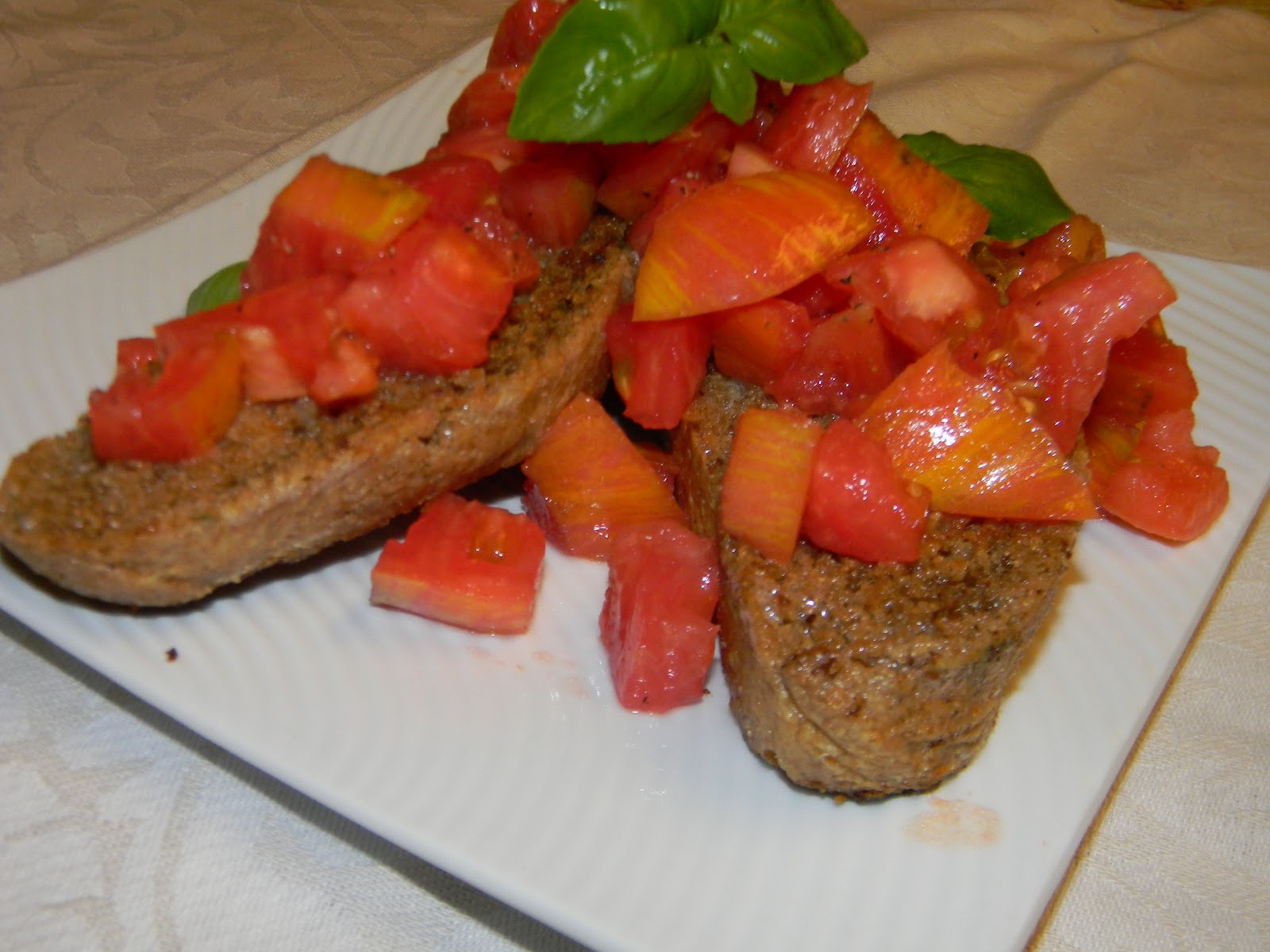
So I made the bread this afternoon. It is so easy and only takes about 10 minutes of your time. The rest is just time for the dough to rise and baking time.
Bread Recipe:
2 c. whole wheat flour
1 c. bread flour
1 1/2 c. water
1 pkg. yeast
1/2 tsp. sugar
1/2 tsp. salt
olive oil, drizzle
Knead 10 minutes. TIP: if you have a Kitchen-aid mixer, attach the dough hook turn it on and just add the ingredients in as it does the work. It does not need to be dough before you use the hook. Let rise for 45-60 minutes. Bake in 350 degree oven for 35 minutes. Oh yeah, I almost forgot....this time I put fresh chopped garlic and thyme in it.
See the slivers!!! This addition really gives it some
great flavor and aroma.
Time to make the sandwich...
cut slices
heat butter
choose tomatoes
chop tomatoes
add salt and pepper
cook each side in butter- think crispy like grilled cheese
top with any herb or not...I chose basil
What an amazingly simple meal! I might have this for breakfast too! Kidding, how can I skip my morning smoothie?
(You might say that is quite a large portion of bread! I normally only eat bread/refined carbs at one meal if at all. The rest of today I ate a giant smoothie, salmon salad {canned salmon, canola mayo, celery, carrots, spicy mustard}, tossed salad w/ homemade parmesan pepercorn dressing, and this sandwich. Not too shabby!!!
I can honestly say that I just had an a-haaa! moment (followed by a DUH! moment). I was stressing in my head over all of the things that I signed myself up to do and all of the things that are required of me over the next few months. And just like that, I said to myself, "Self, you are always going to be busy. There are always going to be too many things to do and not enough time. But it doesn't matter, because as long as you have mostly productive days and strive to move forward with your goals, you will be doing a great job."
Talk about improvement! A year ago I would have worked myself into a panic attack at 6:30 AM. Thank goodness that I do not have anxiety anymore! Other things I learned today:
how to get yourself kicked off of Twitter in 1 business day
I love working from home...I get so much more done.
the active time (meaning the time you actually have to be doing something) for baking bread is about 10 minutes, give or take, unless you want to get fancy. Why don't more people make their own delicious bread?
I hate working out. Lucky for me I trade my website skills for my 5STAR's workout skills.
S-H-I-T I have to weigh-in tomorrow and I just thought about all of the damage I did during my non-stop-birthday-blowout-weekend and my insufficient workouts since.
I actually do like chicken (it came from the farm, not a factory so I feel better about eating it). Especially when the Boyfriend cooks it for me! We have a new chef in town!!!
Maybe all of the chicken I ate this week will turn into muscle to counteract all of the fat that I probably gained back.
My taste buds are changing and I am starting to not notice the vegetables in my smoothies as much.
Looks good doesn't it? haha
Trust me this was amazing compared to what I thought it was going to taste like. Today's green smoothie was:
1/2 pineapple
1 green apple
green grapes
1/2 cucumber
spinach, large handful
kale, handful
water
You might get another post from me later when my bread is done and I turn it into a deliciously simple meal. I'm sorry but I wish I could give you food through the computer. Hey Google or Mark Zuckerberg....maybe you could start working on that.
I have been hearing about GMO foods more and more recently and thought it would be prudent to do a little research. What I have found is pretty disturbing. It all leads back to one company, Monsanto, and their monopoly on the agriculture business. I am not anti-big business. I am anti-big-businesses-that-are-in-bed-with-big-government.
Now how do scientists make genetically "superior" plants? Bacteria. Sounds like it could be a public health concern right? Yeah, I thought so too.
FYI...it's not just corn and soy that is being genetically modified.
You may be aware that many corn and soy crops in the United States are GM, but it may surprise you to learn that a significant portion of U.S. milk is actually genetically engineered, again thanks to Monsanto. This milk, and the ice cream, cheese, and myriad of other dairy products made from it, contains genetically engineered bovine growth hormone, or rBGH.
U.S. milk producers treat their dairy cattle with rBGH because it boosts milk production. But this artificial growth hormone also increases udder infections in cows, leading to pus in the milk along with excessive use of antibiotics in the cows, which is triggering the creation of antibiotic-resistant superbugs and leaving residues of antibiotics in your dairy. Worse still, milk treated with rBGH also contains higher levels of insulin-like growth factor (IGF-1), a hormone linked to breast, prostate and colon cancers in humans. (original source)
Numerous studies have shown that GM corn causes significant changes to blood cells, kidneys, and the liver. It has also been blamed for potentially life-threatening allergies that have occurred in some people. Even if this sweetener had any health benefits (and it doesn't), the risks of consuming a substance made from genetically modified corn would not be worth the rewards. Why then, would you want to take the risks when there are absolutely no health rewards? (original source)
The simplest way to avoid GM foods is to buy whole, certified organic foods. By definition, foods that are certified organic must never intentionally use GM organisms, produced without artificial pesticides and fertilizers and from an animal reared without the routine use of antibiotics, growth promoters or other drugs. Additionally, grass-fed beef will not have been fed GM corn feed.
I do not buy all organic fruits and vegetables, but I do buy strictly organic dairy, I have stopped buying heavily processed foods, stopped buying anything with soy in it, and buy my meat and eggs from a local farm. You do not have to go 100% organic to get most of the benefits of eating a non-GMO diet.
It is that time of year. The sun is going down around 7pm. The leaves are starting to change colors. People are getting sick. NOT ME!
In the summer I make a point to get as much sun as I possibly can. I sit in the sun for about 20 minutes without any sunscreen on and soak up the rays. Then of course I lather up with 30-50 SPF depending on my length of time I plan on being at the beach. I used to, however, put sunscreen on before I even left the house. I used to get sick quite a bit.
I never get sick in the summer any more, but usually I am fighting off colds all winter long popping vitamins and drinking loads of tea. Well last year I started tanning regularly around the holidays because I had been sick a handful of times that fall, and guess what? I stopped getting sick.
Almost everyone I talk to about the fact that I tan (in tanning beds) says "What the hell are you doing? Tanning beds cause skin cancer!" Well I beg to differ. BURNING causes skin cancer. The tanning beds give off the same types of light as natural sunlight. Tanning has received bad press because of everyone's fear of skin cancer and wrinkles. Misinformed politicians are sticking their noses where they don't belong (where do they belong?) and scaring people into believing something that is just wrong. The sun should not be feared...they key is to not burn. At the end of every summer, before my tan fades, I start tanning a few times a week. I start off with a few minutes (4-5) and work up over the course of a month or so to 9-10 minutes.
I don't usually get sick. However, sometimes when I let myself get rundown and low on sleep, I start to feel that pre-sick feeling- like you know that if you don't do something fast you are going to be full blown sick. That happened to me on Monday (the day after my nonstop-blowout-birthday-weekend). In the middle of the day I started to feel that back of the throat tickle, ache behind the eyes, ears are getting clogged feeling. Lucky for me I live 1/2 mile from the beach, I was at home, and we were at the end of an Indian summer. Needless to say I went and plopped my exhausted self on the beach for about 2 hours with no sunscreen. I didn't feel better right away, but low and behold I woke up yesterday morning and felt completely fine!
I urge everyone who lives in colder climates to think about tanning in the winter. Do your own research, and no matter what DON'T LET YOURSELF BURN! Below is a brief video and some great information on sunlight, vitamin D, and cancer prevention.
New Model Of Cancer Development: Vitamin D is the Key By Dr. Mercola (Original Source)
Researchers studying the preventive effects of vitamin D on cancer have proposed a new model of cancer development that hinges on a loss of cancer cells' ability to stick together. The model, dubbed DINOMIT, differs from the older model of cancer development, which suggests genetic mutations as the earliest driving forces behind cancer.
"The first event in cancer is loss of communication among cells due to, among other things, low vitamin D and calcium levels," said epidemiologist Cedric Garland. "This loss may play a key role in cancer by disrupting the communication between cells that is essential to healthy cell turnover, allowing more aggressive cancer cells to take over."
Garland suggests that such cellular disruption could account for the earliest stages of many cancers. Previous theories linking vitamin D to certain cancers have been tested and confirmed in more than 200 epidemiological studies, and understanding of its physiological basis stems from more than 2,500 laboratory studies.
Each letter in DINOMIT stands for a different phase of cancer development – disjunction, initiation, and natural selection, overgrowth of cells, metastasis, involution, and transition. While there is not yet definitive scientific proof, Garland suggests that much of the evolutionary process in cancer could be arrested at the outset by maintaining adequate vitamin D levels.This latest study, published in theAnnals of Epidemiology, is yet another piece in what’s turning into amountain of evidence showing vitamin D’s effectiveness for a wide variety of cancers. 800+ links showing vitamin D’s effectiveness on cancerThe idea of getting sun exposure in order to stay healthy is such a simple strategy it’s easily dismissed in this age where so many folks believe health comes in a pill and costs a fortune. But it’s true, and with the mounting evidence, not even conventional medicine can ignore it any longer.
In fact, some of the top vitamin D experts in the world believe optimizing your vitamin D levels by getting proper sun exposure is the next largest variable after smoking that can influence whether or not you’ll get cancer.
I am a bit surprised at that comment as from my understanding vitamin D has a far more profound impact on cancer. Vitamin D seems to universally lower risk for nearly all cancers where smoking is primarily restricted to lung cancer. And if you took vitamin D as a smoker you would still radically reduce your cancer risk.
Here’s why:
Receptors that respond to vitamin D have been found in almost every type of human cell, from your bones to your brain.
Your organs can convert the vitamin D in your bloodstream into calcitriol, which is the hormonal or activated version of vitamin D. Your organs then use it to repair damage, including that from cancer cells.
So how can you get enough vitamin D? Well, you can get it in your diet by eating fish or taking vitamins, however there are a few problems with those options. First is that you would have to eat a ridiculous amount of fish to obtain the daily requirement, and second when you take an oral vitamin D pill it is the end result. When your body absorbs sunlight (UVA & UVB rays) there are several steps from absorption to synthesis of vitamin D, all are equally important.
It’s important to realize that your ideal source is fromappropriate sunshine exposure. Your body can safely create as much as 20,000 units a day this way, without any risk of overdosing – a factor you’ll have to contend with if you’re taking oral supplements.